Fanfic to anime, with your cast still recognizable
You have already written the hard part. C2Anime takes fanfic to anime the way an adaptation actually works: it reads your chapter, breaks it into scenes, keeps your dialogue as dialogue, designs your cast once, and renders voiced anime scenes where the same characters show up looking like themselves every time.
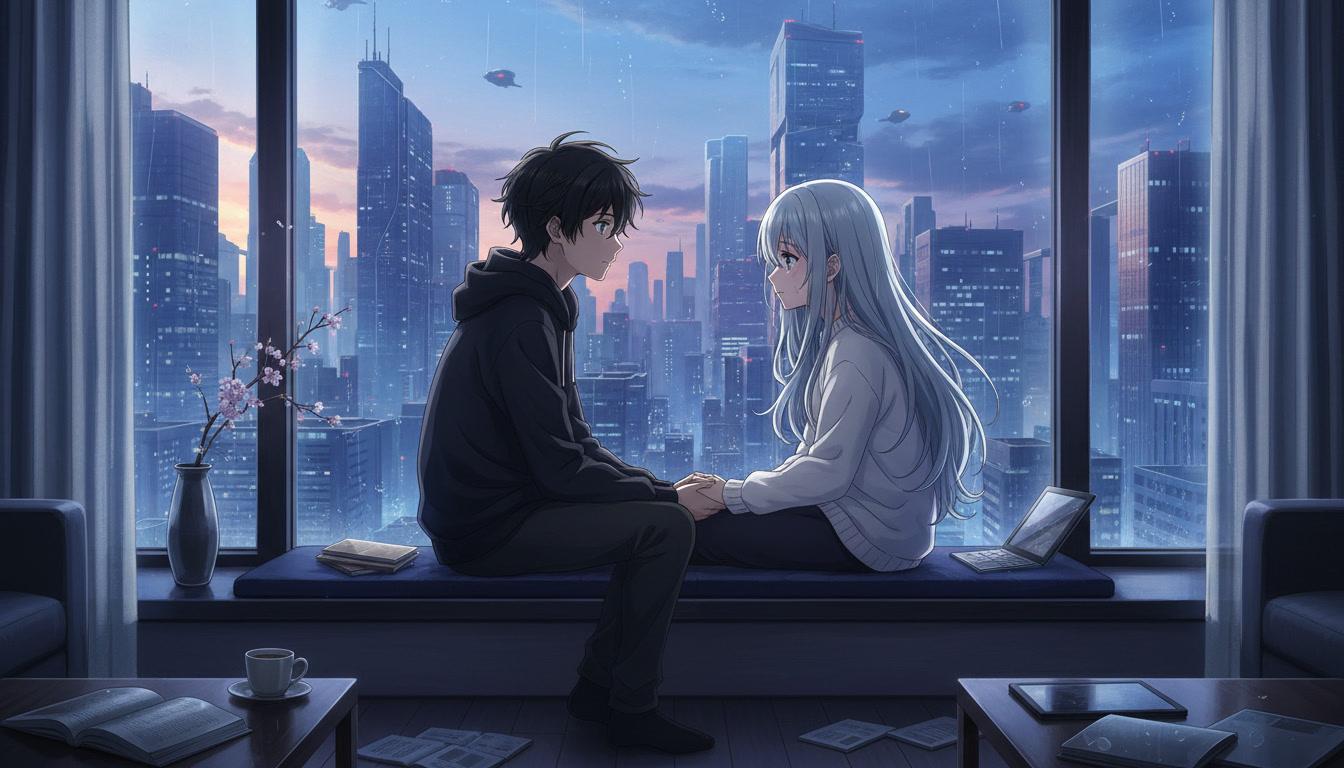
How fanfic to anime works here
Three stages, in this order. The order is why the finished scenes hold together instead of drifting.
Paste the chapter
Drop in a scene, a chapter or the whole fic. C2Anime reads prose the way an adapter does — finding the beats that have to be on screen and the dialogue that has to be heard.
Lock the cast
You describe how your version of each character looks. Those designs become fixed references, so the people in chapter one are the same people in chapter nine.
Watch the scenes render
The screenplay comes first, then staging, then voiced anime scenes that run in order instead of arriving as unrelated clips.
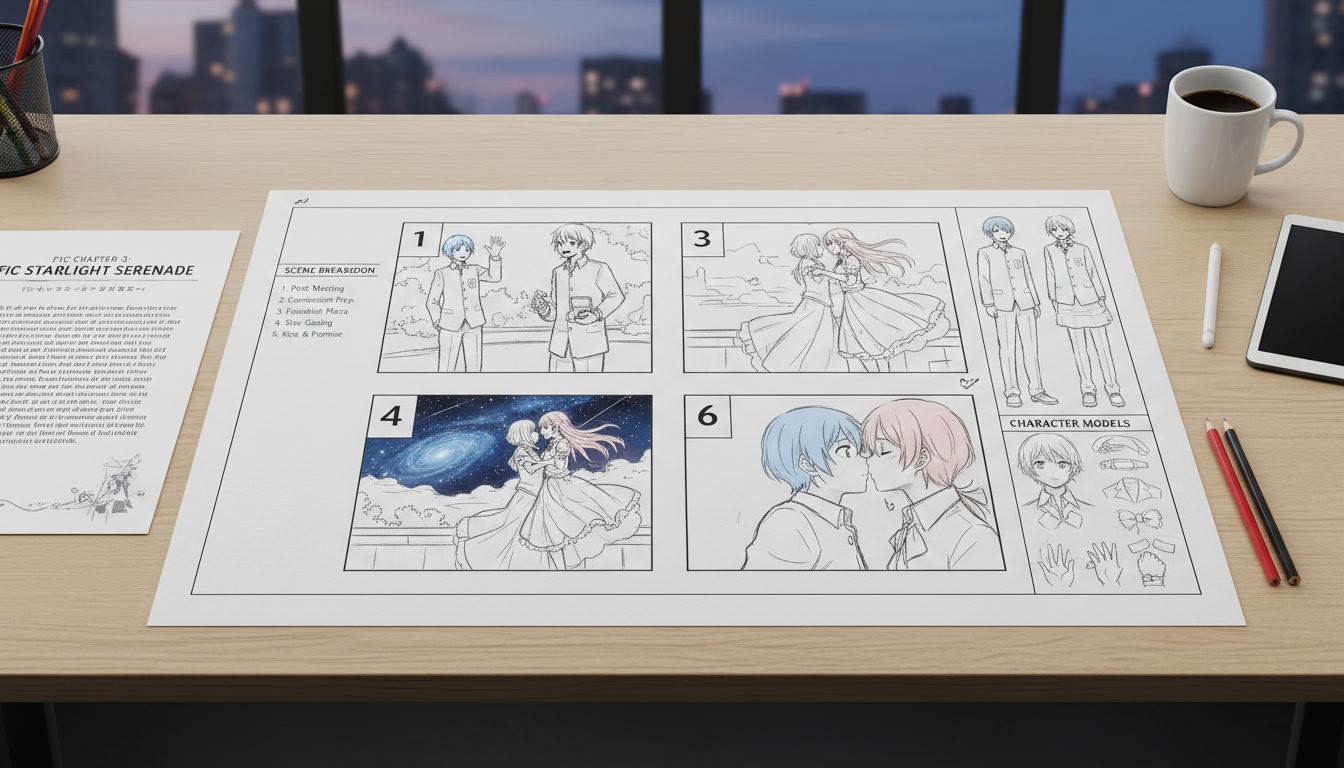
Why fic breaks shot-by-shot tools
Fanfiction is the worst possible input for a tool that renders one prompt at a time, and it fails in ways fandom notices instantly. The point of a fic is that you already know these people. So when a character's eye colour shifts between two shots, or the coat they have worn for three chapters loses its collar, the illusion does not survive it.
The second problem is structure. Fic runs on long conversations, callbacks and slow-building tension. A clip generator has no memory of the previous shot and no plan for the next one, so a ten-minute chapter comes back as a handful of pretty, unrelated moments with the actual story missing.
C2Anime works in the other order. Structure and screenplay first, character references second, rendering last. Every shot is made against a plan that knows who is in the scene, what they just said and where the chapter is going.
Your version of the characters, held steady
Every fic writer has a specific picture in their head. The exact length of the hair. Which one slouches. The jacket that shows up in every scene because it means something. Ask an image generator for that twelve times and you will get twelve different people.
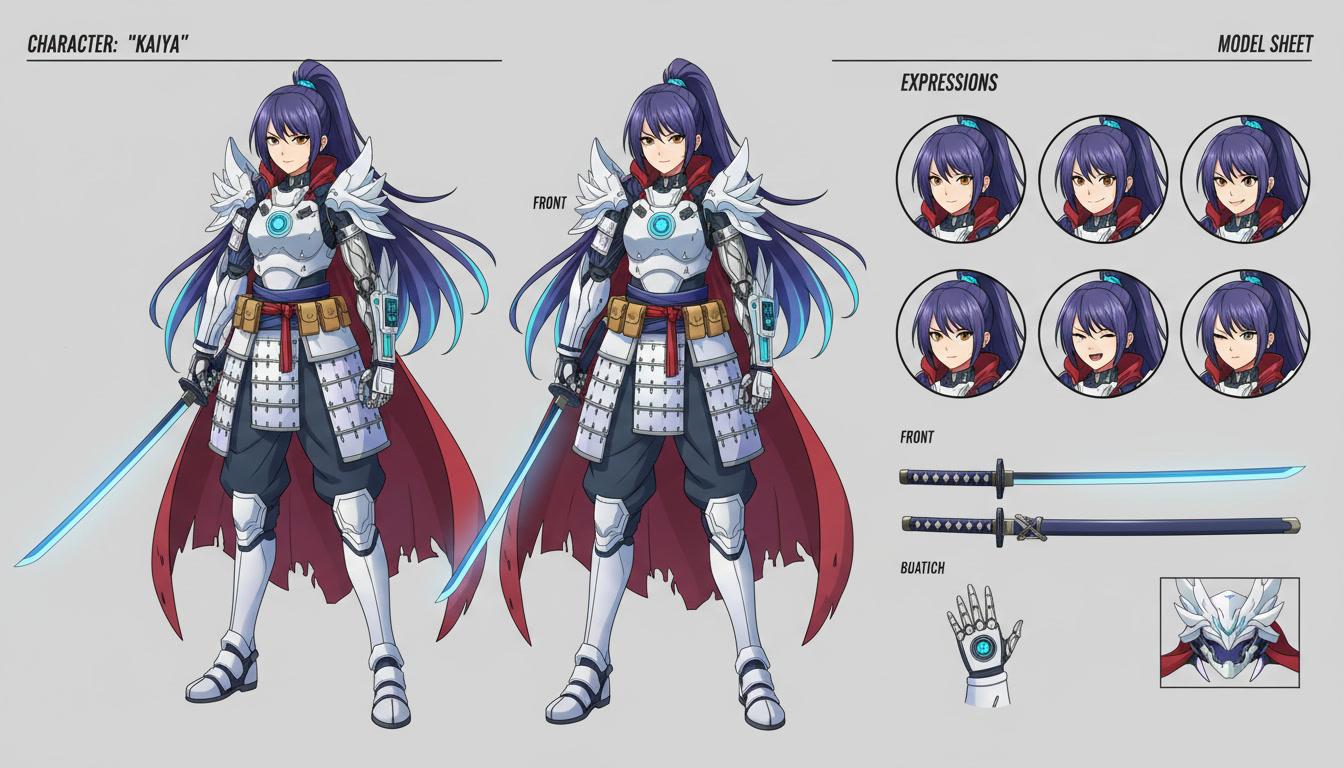
Here you describe each character once and that description becomes a model sheet — front view, three-quarter view, a row of expressions. Every scene the character appears in is rendered from that same sheet, so scene nine matches scene one without you re-explaining anything.
It is also what makes a multi-chapter adaptation possible. The same cast carries from one episode into the next, which is the difference between a series and a folder of test renders.
What fanfic to anime needs to get right
Six things that decide whether an adaptation reads as your fic or as generic anime footage.
Your cast stays recognizable
The reason fanfic to anime usually fails is that faces drift between shots. C2Anime designs each character once and reuses that reference for every scene they appear in.
Your dialogue survives
Fic is carried by dialogue. The screenplay stage keeps your lines as lines — spoken by characters in a scene, not summarised by a narrator.
Voices that stay put
Each character gets a voice and keeps it across the runtime, which is what makes a long conversation scene readable at all.
Chapters, not clips
A fic chapter is minutes of story, not seconds. Scenes are planned as a whole so a setup early on can pay off later.
Slow scenes are allowed
Two people talking by a window is a real scene in fanfiction. Staging and framing are planned for quiet emotional beats, not just action.
Your interpretation, held
The way you picture a character — the haircut, the jacket, the expression they default to — is captured in a design sheet and applied consistently.
What writers bring to it
The long-runner. Two hundred thousand words in and readers still ask for a trailer. One chapter — usually the one everyone quotes — turns into a sequence that gives the fic a face.
The one-shot. A single emotional scene is already the right shape for a short. Dialogue, two characters, one room, one turn. That adapts almost directly.
The original-world writer. If the cast and setting are yours from the start, the same pipeline is simply an adaptation of your own novel, with nothing borrowed at all.
The archivist. Older fics that never got art can finally have some — model sheets for the cast and a scene or two that shows what the writing has been describing all along.
Fanfic to anime: common questions
- How does fanfic to anime actually work?
- You give C2Anime the text of your fic. It reads the prose, proposes a scene breakdown, writes a screenplay with your dialogue in it, builds a character reference for each person in the cast, and then renders voiced anime scenes against that plan. You review the breakdown and the screenplay before anything is rendered.
- How long a fic can I adapt at once?
- Work chapter by chapter. A single chapter is usually the right unit — enough story for a complete sequence with a beginning and an end, and short enough that the plan stays reviewable. Longer fics become a run of episodes that reuse the same cast.
- Will the characters look the same in every scene?
- That is the part this is built for. Character designs are fixed before rendering starts and reused for every appearance, so hair length, outfit details and face do not change between shots the way they do with shot-by-shot prompting.
- What about characters from an existing series?
- You write the description, so what gets rendered is your interpretation of how a character looks in your fic — an original design in an anime style, held consistent across scenes. Whatever you make is yours to keep private or share, and the usual rules for fan works apply to how you publish it.
- Does my prose need to be formatted a certain way?
- No. Ordinary fic prose works — narration, dialogue tags, scene breaks and all. Clear scene breaks and named speakers help the adaptation follow your intent more closely, but nothing needs rewriting first.
- Can I change the plan before it renders?
- Yes. The scene breakdown and the screenplay are both editable, and individual scenes can be re-rendered without redoing the whole video.
- Do I need animation or editing experience?
- No. Animating fanfiction here is a writing and directing job: you supply the fic, the character descriptions and your opinions about tone. Staging, timing and rendering are handled for you.
Bring a chapter. Leave with a scene.
You wrote it. Now watch the cast say the lines out loud.
Animate your ficAdapting fanfic to anime without losing the characters
Going from fanfic to anime is an adaptation problem before it is a rendering problem. Prose can carry a ten-minute conversation in a paragraph of interiority; a screen cannot. Somebody has to decide which beats become scenes, which lines get spoken aloud, where the camera sits during the quiet part, and what each character looks like when they finally appear. C2Anime makes those decisions explicitly and shows you the plan — a scene breakdown and a screenplay drawn from your own text — before a single frame is rendered.
The failure mode for every other route from fanfiction to video is continuity. Fandom reads for recognition: these are people readers already know, and a face that changes between shots breaks the spell faster than any weakness in the animation itself. That is why the cast is handled first here. Each character is designed once into a reference sheet, and every later scene renders from that sheet, so a coat, a scar or a specific silhouette survives the whole runtime instead of being re-invented per shot.
Dialogue is the other half. Fic lives in what people say to each other, so animating fanfiction convincingly means voiced characters holding a scene, not a narrator summarising over still images. C2Anime writes a real screenplay from your prose, assigns a voice to each character and keeps that voice consistent, which is what lets a long two-hander read on screen at all. Scenes are planned as a run, so a look exchanged early can mean something later.
Practically: work a chapter at a time, describe your cast the way you picture them, edit the breakdown until the beats match your intent, and render. Long fics become a series of episodes that reuse the same cast rather than a pile of disconnected clips. Whether you are adapting a two-hundred-chapter epic, a single one-shot, or an original story with a world entirely your own, fanfic to anime starts the same way — with the text you already wrote. C2Anime is in invite-gated Early Access; see pricing for the current credit tiers, or head to create to begin.